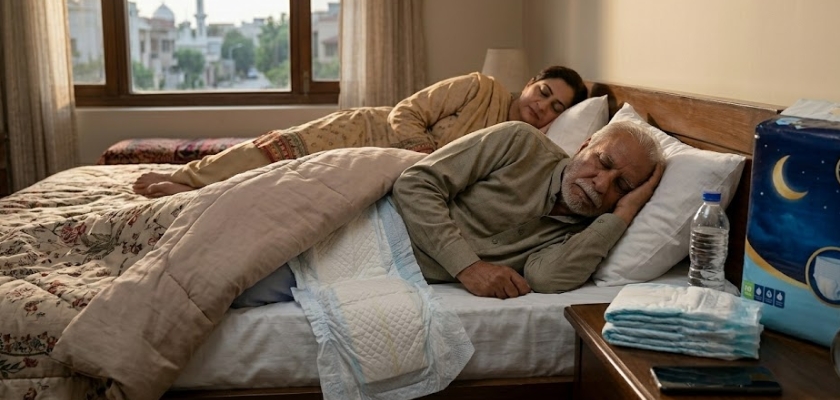
Nighttime incontinence is a different challenge from daytime incontinence. During the day, a carer can check every 2–3 hours and the patient can often signal their needs. At night, the diaper may be worn for 7–9 hours with no change — putting significant demands on the product and the skin underneath it.
This guide covers how to choose the right overnight diaper for use in Pakistan, how to maximise its protection time, and how to create a safe, skin-protective overnight routine so that both patients and caregivers can sleep through the night.
For day-time application steps, read the complete adult diaper care guide Pakistan.
What Makes an Overnight Diaper Different?
| Feature | Daytime Diaper | Overnight Diaper — Requirements |
|---|---|---|
| Wear time | 4–6 hours | 7–9 hours minimum |
| Absorbency | Moderate | High to maximum — must hold full night’s output |
| Skin protection | Standard barrier | Enhanced breathability essential — heat builds up over 8 hrs |
| Leak protection | Standard cuffs | Reinforced leg cuffs — repositioning during sleep dislodges standard cuffs |
| When to change | When wetness indicator fades | Only if fully saturated; one night check at 2–3am is ideal |
| What to use alongside | Optional underpad | Underpad always required for bedridden patients overnight |
Which Diaper to Use Overnight in Pakistan
For overnight use, tape-style diapers are strongly preferred over pull-ups because:
- Tape diapers generally have higher absorbency capacity than pull-ups in the same size
- Tape diapers can be re-applied by a caregiver if the patient moves significantly during sleep
- For bedridden patients — the primary overnight user group in Pakistan home care — tape diapers are the only practical option
Sofped Tape-Style Diapers (L or XL) are the recommended overnight product within the Sofped range. Use paired with Sofped Underpads for bedridden patients.
For mobile seniors who prefer pull-ups, use the largest available size at night (XL for larger patients) and accept that the caregiver may need to check once during the night.
The Overnight Protection Routine — Step by Step
- Start the evening routine 1 hour before the patient sleeps (approximately 9–10pm).
- Perform a full clean diaper change — fresh diaper, clean skin.
- Apply a generous barrier cream layer — more than daytime use. Cover the entire diaper contact area.
- Allow skin to breathe for 5 minutes before applying the overnight diaper.
- Apply the overnight tape diaper, ensuring a snug but comfortable fit. Double-check leg cuffs are standing upright.
- For bedridden patients: lay a fresh Sofped underpad flat beneath the patient.
- Set a 2–3am reminder to briefly check the wetness indicator. If fully saturated, perform a quiet change. If only partially used, let the patient rest.
- Full morning change at 6–7am with skin wash, barrier cream, and fresh underpad.
Pakistan Summer Tip: In hot months (May–September), overnight diaper rash risk is highest due to heat buildup. Use a battery-operated fan in the room and choose breathable cloth-backed diapers rather than plastic-backed options. Apply extra barrier cream.
Heat rash risk is highest at night. Learn how to prevent adult diaper rash Pakistan with proper barrier cream use.
Managing Nighttime Changes Without Disrupting Sleep
For caregivers sharing a room or home with the patient, minimising disruption at night is important for their own health too. These techniques help:
- Keep all change supplies (gloves, wipes, cream, fresh diaper, bag) pre-assembled in a small bedside basket
- Use a small torch/mobile phone light rather than turning on ceiling lights
- Keep wet wipes at body temperature by placing them under your pillow (wrapped) or in a warm-water-heated pouch
- Change only when absolutely necessary — a partially-used overnight diaper does not need changing if the skin is not at risk
- Speak softly and reassuringly during night changes — orienting the patient prevents distress
When to See a Doctor About Nighttime Incontinence
Nighttime incontinence (nocturia or nocturnal enuresis in adults) can be a symptom of:
- Urinary tract infection (UTI) — sudden onset or worsening overnight leakage may signal UTI
- Prostate enlargement in men — common cause of frequent nighttime urination
- Uncontrolled diabetes — excess blood sugar causes increased urination
- Sleep apnoea — disrupted breathing triggers urination
If a patient’s overnight incontinence has suddenly worsened, or if they are passing unusually large volumes at night, consult a doctor before assuming this is simply an incontinence management problem.
FAQs — Overnight Adult Diapers
How many hours can a Sofped tape diaper last overnight?
Sofped tape-style diapers in L and XL provide 6–8 hours of protection under moderate incontinence conditions. For heavy overnight incontinence, pair with an underpad and consider a 2–3am check.
Is it safe to leave a diaper on all night without checking?
For mobile patients with light incontinence: generally yes, if the diaper was applied 1–2 hours before sleep. For bedridden patients with heavy incontinence: a 2–3am check is recommended.
What can I do to prevent leaks onto the mattress overnight?
Always use a Sofped underpad beneath a bedridden patient overnight. For extra protection, add a waterproof mattress protector under the bedsheet.