Introduction
One of the most common questions from families new to incontinence care in Pakistan is simple: diaper, pull-up, or underpad — which one do I actually need? The honest answer is that most care situations benefit from more than one product type, each serving a different purpose. This guide breaks down the real differences so you can buy the right combination the first time, rather than guessing and reordering.
New to adult diapers entirely? Start with our adult diapers buying guide to understand sizing and absorbency basics first.
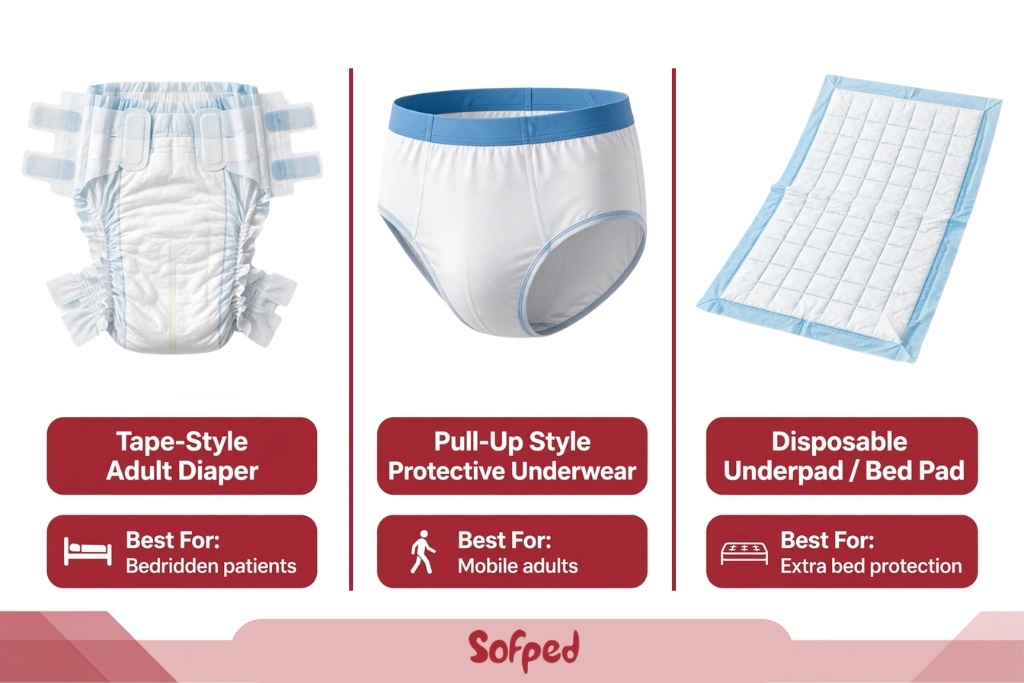
Adult Diapers vs Pull-Ups vs Underpads: Quick Comparison
| Product | Best For | Key Advantage | Limitation |
|---|---|---|---|
| Tape-Style Diaper | Bedridden patients, heavy incontinence, caregiver changes | Can be changed lying down, adjustable tabs | Bulkier, not for active users |
| Pull-Up Underwear | Mobile adults, moderate leakage, independence | Worn like regular underwear, discreet | Needs wearer to stand/pull up/down |
| Underpad / Bed Pad | Extra bed/furniture protection, overnight | Protects mattress, reduces laundry | Not worn on body, doesn’t replace diaper |
Adult Diapers (Tape-Style Briefs)
Tape-style adult diapers use adjustable side tabs, allowing them to be fitted and refitted without the wearer needing to stand or fully undress.
- Best for: bedridden patients, limited mobility, heavy urinary or bowel incontinence, caregiver-assisted changes
- Key advantage: can be changed while the patient is lying down, and the tabs allow fine-tuning of fit
- Limitation: bulkier than a pull-up, generally not ideal for active, independent users
Pull-Up Style Protective Underwear
Designed to be worn and removed like regular underwear, pull-ups suit users who are mobile and can manage their own toileting and changes.
- Best for: active, independent adults with moderate incontinence; users who want a discreet, underwear-like feel
- Key advantage: preserves independence and normalcy for daily activities, prayer, and social occasions
- Limitation: requires the wearer to be able to pull the product up and down themselves, or stand with support for a caregiver to assist
Underpads (Bed Pads / Chair Pads)
Underpads are placed on top of a mattress, sofa, or wheelchair seat to catch leaks and protect the surface underneath — they’re a supplementary layer, not a replacement for a diaper or pull-up.
- Best for: extra bed and furniture protection, particularly overnight or during illness recovery; available in both disposable and washable versions
- Key advantage: protects mattresses and furniture from repeated exposure to moisture, reducing cleaning and replacement costs
- Limitation: does not replace a diaper or pull-up — it’s designed to catch overflow, not to be worn on the body
Which Combination Should You Buy?
- Bedridden patient, heavy incontinence: tape-style diaper + disposable underpad for the bed
- Active, mobile adult, moderate leakage: pull-up style underwear alone is usually sufficient
- Postpartum recovery: adult diaper or high-absorbency pull-up for the first one to two weeks, with an underpad for extra bed protection at night
- Wheelchair user: pull-up or diaper depending on mobility level, plus a washable or disposable underpad on the wheelchair seat
- Light leakage only: a bladder control pad worn inside regular underwear may be enough, without needing a full diaper.
For details and guidance by specific patient type see Incontinence in Pakistan: Complete Guide for Families
Common Mistakes to Avoid
- Buying only underpads and assuming they replace a diaper — they don’t manage leaks on the body itself
- Choosing a pull-up for a bedridden patient, making changes far more difficult for the caregiver
- Underestimating overnight needs and using a daytime-absorbency product for a full night’s sleep
- Buying a single product type when a combination (e.g., diaper + underpad) would offer better overall protection
Frequently Asked Questions
Can I use just an underpad instead of a diaper?
No — underpads only protect the surface beneath the patient and don’t absorb leaks directly against the skin the way a diaper or pull-up does. For most incontinence care situations, an underpad should be used alongside a diaper or pull-up, not instead of one.
What’s the real difference between a diaper and a pull-up?
A diaper (tape-style brief) uses adjustable side tabs and can be fitted while the wearer is lying down, making it easier for caregiver-assisted changes. A pull-up is worn and removed like regular underwear, suiting mobile, independent users.
Do I need both a diaper and an underpad?
For bedridden patients or anyone with heavy overnight leakage, yes — the diaper manages leaks on the body, while the underpad adds an extra layer of protection for the mattress or furniture underneath.
Which product is best for a wheelchair user?
This depends on the person’s mobility and hand function — some wheelchair users prefer pull-ups for independence, while others with more limited mobility do better with a tape-style diaper. A washable or disposable underpad on the wheelchair seat adds extra protection either way.
Conclusion
Diapers, pull-ups, and underpads each solve a different problem, and most incontinence care situations benefit from the right combination rather than a single product type. Match the choice to mobility level and severity of leakage, and add an underpad wherever extra surface protection is needed.