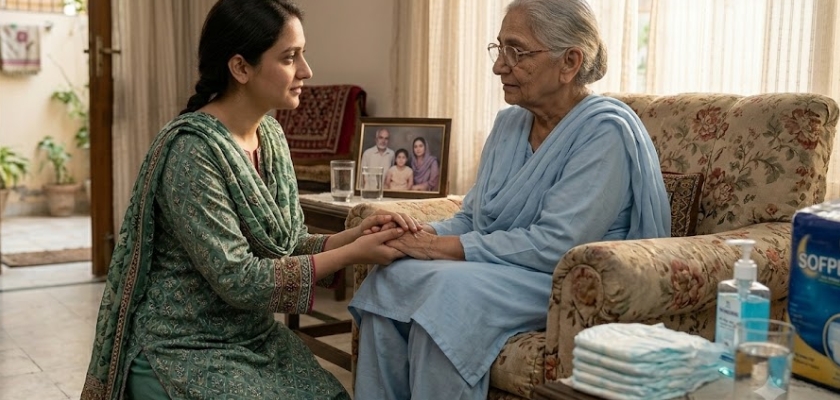
How to Talk to Your Elderly Parent About Wearing Adult Diapers — A Pakistan Family Guide
This is one of the most difficult conversations Pakistani families face. Our culture places deep respect for elders at its centre — and for many older Pakistanis, the idea of wearing what they perceive as a ‘baby’s product’ feels deeply humiliating, a symbol of lost independence and dignity.
Yet the conversation is necessary, and it is possible to have it in a way that preserves your parent’s dignity, strengthens your relationship, and opens the door to a solution that genuinely improves their quality of life. This guide walks you through every step — from choosing the right words to handling refusal — with the Pakistani family context in mind.
This conversation is only one part of home care, so families should also follow our complete adult diaper care guide Pakistan for changing routines, skin protection, overnight care, and daily hygiene.
Why Elderly Pakistanis Resist Adult Diapers
Understanding the specific resistance makes the conversation more compassionate and effective:
| Common Resistance | Why It Feels That Way | How to Reframe It |
|---|---|---|
| ‘It’s for babies’ — shame | Diapers are culturally associated with helplessness and infancy | Use different language: ‘protective undergarment’, ‘medical pad’, ‘hospital briefs’ |
| ‘I am not that bad yet’ | Incontinence worsens gradually; the patient may genuinely not realise the impact | Gently describe specific incidents they may have minimised |
| ‘What will people say’ | Pakistani social culture is collective; perceived judgement matters deeply | Emphasise that it is completely private and invisible under clothing |
| ‘I don’t need it — I can manage’ | Pride and self-reliance are highly valued, especially in men | Frame it as managing better — it gives them control, not takes it away |
| ‘It is too expensive’ | Valid economic concern in many Pakistani households | Sofped provides affordable Pakistani-made options with COD — no financial barrier |
| Religious concern — taharat | Some elderly Muslims worry about purity for prayer | Consult with a local Islamic scholar — most affirm that managing incontinence preserves wudu principles rather than violating them |
Language Matters — What to Say and What to Avoid
Words to Avoid
- Avoid ‘diaper’ (ڈائپر used in infant context) — triggers immediate resistance
- Avoid ‘you are wetting yourself’ — shaming language closes conversation
- Avoid ‘you have no choice’ — removes agency; escalates refusal
- Avoid discussing the topic in front of other family members — privacy is essential
Words to Use Instead
- ‘Protective undergarment’ or ‘medical protection pad’ (حفاظتی جانگھیا یا طبی پیڈ)
- ‘Many respected elders use these — even doctors recommend them’
- ‘It means you can go to the mosque/family events without worry’
- ‘This is just like glasses for the eyes or a walking stick — a practical aid’
- ‘It is completely invisible under your shalwar — no one will know’
How to Start the Conversation
- Choose a private, calm moment — not during an accident or directly after one.
- Sit at the same level as your parent — not standing over them.
- Start with empathy, not the solution: ‘Abba/Ammi, I want to talk about something that I think will make life more comfortable for you. I’m raising this because I care about you, not to embarrass you.’
- Describe what you have observed, in neutral terms: ‘I’ve noticed you sometimes rush to the bathroom or have had a few accidents. I want to help you manage this better so you can move around more freely.’
- Introduce the product as a practical tool — not a last resort: ‘I’ve read about protective undergarments that many active seniors use when they travel or attend events. They’re invisible under clothing and meant for exactly this.’
- Offer to try together: ‘I’ve ordered a pack — can we just try one and see if it’s comfortable? You can stop any time.’ Families can choose Sofped adult diapers Pakistan for private home delivery, Cash on Delivery, and practical absorbency options for elderly care.
- Accept that the first conversation may not succeed. Leave it open: ‘No pressure. I’ll leave the pack here if you want to try one.’
Once your parent agrees to try one, the next step is to learn the correct wearing and changing method from our how to use adult diapers Pakistan guide. Before opening the first pack, check waist and hip measurements carefully because the wrong size can cause leakage, discomfort, or refusal; our adult diaper size guide Pakistan explains how to choose the correct fit.
When the Parent Has Dementia or Cognitive Decline
For a parent with dementia, the standard conversation approach does not work. Logic-based arguments are ineffective because the patient cannot process them. Instead:
- Use distraction — provide a preferred activity, food, or sensory comfort before and during the change
- Make the process routine and predictable — same time, same caregiver, same calm words each time
- Use soothing, simple instructions: ‘Let me just make you comfortable’ rather than explanations
- Do not ask permission — frame it as routine care: ‘Time to freshen up’
- Consult the patient’s neurologist or GP for specific dementia-care guidance
Caregiver Self-Care — Managing Your Own Emotions
Many Pakistani children feel a complex mix of guilt, grief, and frustration when a parent begins to need incontinence care. This is normal and does not make you a bad carer. Acknowledge these feelings — speak to a trusted friend, religious counsellor, or doctor if they become overwhelming. Your wellbeing directly affects the quality of care you provide.
If you are willing to know more about incontinence read complete guide for Incontinence in Pakistan.
FAQs — Talking to Parents About Adult Diapers
My father is a proud man and absolutely refuses. What can I do?
Respect his autonomy while protecting his safety. Increase bathroom accessibility first (grab rails, bedside commode). Return to the conversation gently in 2–4 weeks. If accidents are causing falls or skin problems, involve the GP — sometimes a medical recommendation lands better than a family one.
My mother thinks wearing a diaper means she is dying. How do I address this?
This is a fear, not a logical belief — address it as a fear. ‘Ammi, millions of healthy active adults use these — they play golf, drive, go to masjid. It is not about how ill you are; it is about being comfortable.’ Show her marketing imagery of active adults using incontinence products if possible
Should I involve the doctor in this conversation?
Yes, if direct family approaches are not working. A GP’s recommendation carries significant authority in Pakistani family dynamics. Ask the doctor to raise the topic matter-of-factly during a routine appointment.
If you are caring for an elderly parent in Karachi, you can also check adult diapers Karachi for local ordering and delivery options.