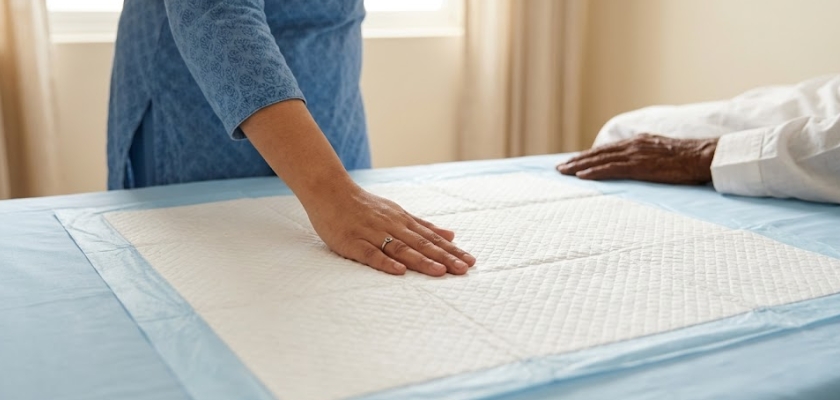
Whether caring for a bedridden parent, a post-operative patient, or an elderly family member at home, underpads are one of the most practical and overlooked products in incontinence care. Also called dignity sheets or bed pads, underpads lie under the patient — protecting the mattress, bed linen, and chairs from leakage, making cleanup faster and reducing laundry significantly.
Used alongside the Sofped adult diapers Pakistan range, Sofped’s disposable underpads offer hospital-grade protection in a soft, skin-friendly format that is now available online with Cash on Delivery across Pakistan.
What Are Underpads and Why Are They Essential?
An underpad is a flat, single-use absorbent pad placed under a patient or on a surface. Unlike an adult diaper that is worn on the body, an underpad stays in place on the bed or chair beneath the patient, absorbing any leakage that passes through or around the diaper.
They are essential for:
- Bedridden patients who spend long hours in one position
- Patients undergoing diaper changes (placed under patient before removing soiled diaper)
- Protecting mattresses during overnight care
- Hospital and clinic use during procedures and examinations
- Post-surgery recovery where movement is restricted — see adult diapers for post surgery Pakistan.
Sofped Underpad — Features & Specifications
| Specification | Details |
|---|---|
| Size | 60 × 90 cm — hospital standard |
| Top Layer | Soft non-woven — gentle against skin, draws moisture away quickly |
| Absorbent Core | Fluff pulp + SAP — rapid absorption, locks liquid to prevent backflow |
| Back Layer | Waterproof PE film — prevents leakage reaching mattress or chair surface |
| Absorbency | Moderate to heavy — suitable for overnight use |
| Quantity | Pack of 10 / 25 (hospital bulk also available) |
| Disposal | Single-use disposable — fold inward and seal in disposal bag |
Underpad vs Adult Diaper — When to Use Each
A common question from caregivers is whether to use an underpad, a diaper, or both. Here is a straightforward guide:
| Situation | Use Underpad? | Use Diaper? |
|---|---|---|
| Patient is mobile / walking | No (unnecessary) | Yes — pull-up diaper |
| Patient in bed, light incontinence | Yes, underpad only | Optional — depends on severity |
| Patient in bed, heavy incontinence | Yes — as backup layer | Yes — tape diaper + underpad |
| During diaper change procedure | Always — under patient | Yes, new clean diaper |
| Post-surgery patient in hospital | Yes — standard hospital protocol | Yes if catheter not used |
| Protecting a chair / sofa | Yes — place on seat | Not needed unless patient mobile |
For heavy overnight protection, pair the underpad with Sofped tape style adult diapers.
How to Use Sofped Underpads Correctly
- Unfold the underpad with the soft (top) side facing upward.
- Slide under the patient gently — either by rolling the patient to the side or lifting slightly.
- Centre the pad so the absorbent area covers the hip and seat region.
- Smooth out any folds or creases to ensure full contact with the surface.
- After the patient has soiled the pad, fold it inward (soiled side inside) and place in a sealed disposal bag.
- Change underpads at minimum every 4–6 hours, or immediately after bowel movements.
For the full bedside procedure, see: how to change adult diapers.
Frequently Asked Questions — Underpads
Can underpads be reused?
Sofped underpads are single-use disposable products. Reuse is not hygienic and risks skin infection. For reusable options, cotton hospital pads that can be laundered are available separately.
How often should underpads be changed?
Change every 4–6 hours or immediately after any bowel movement. For overnight use, change before sleep and upon waking.
Are Sofped underpads safe for bedsore-prone patients?
Yes. The soft non-woven top layer reduces friction. However, underpads should be supplemented with regular repositioning every 2 hours for bedsore prevention.
Can I use underpads on a sofa or wheelchair?
Yes. Underpads work on any flat surface — beds, chairs, sofas, wheelchairs, or car seats.